A sense of stability in the winds of change

Today the leaves on the trees are rusty red and ochre yellow. The colours this year seem particularly vibrant, perhaps because we had a wetter spring. As the wind gusts, more and more of the branches are being revealed: black tendrils that reach towards the wide open prairie sky. The days are noticeably shorter.

Things are changing.

In response, I am yearning for stability.


I love stability. After the past three-ish years, who doesn’t?! It’s one of the reasons why I was initially drawn to Ashtanga: the set sequence offered certainty, predictability. Life was full of unknowns; at least I could know what the next pose was.

I even used to eat the same breakfast every day (banana, peanut butter, toast). For four years. Then it was yoghurt and granola. For five years. And a half.

A sense of stability is so important if we are to flourish: we can step out of the comfort zone with more confidence if we know there is a safe place to retreat to. A good plan always includes a backup plan.

Then again there is only so much we can anticipate.

Things happen beyond our individual control. The nature of things is change. The leaves scattered outside remind us of this.

We don’t always know what the next step is. Life isn’t a series of postures to dogmatically follow. We don’t know how much rain we’ll get in a year. We can’t control what governments halfway around the world do.

But we do have some say. We can show up on the mat, and work with what’s arising. We can follow our breath, and be caretakers of our bodies. We can vote in our municipal elections. We can put out a barrel, and channel the rainwater towards good things.

These days, I alternate between two breakfasts: oatmeal, or eggs and toast. Baby steps; progress!


Oatmeal or not, I hope that we can all find a sense of agency and stability amidst all of life’s unpredictable moments. The yoga mat or meditation cushion can be a really reliable place to touch into that sense of stability. If you’d like to explore more, join me for a livestream session or dive into a self-paced online meditation course.

May practice be our haven in the winds of change.

Be well,
Adrienne
Listening to our needs

Since summer is really taking her time to arrive, I’ve been biding my time with some *light* reading, namely the book, Living Nonviolent Communication: Practical Tools to Connect and Communicate Skillfully in Every Situation, by Marshall Rosenberg. Not only is it helping to quell my meteorological impatience, but I’ve been finding its lessons – of listening and how to ask for one’s needs – to be sage and perennially relevant.

Much yogic wisdom espouses that the solution to our problems coming from within. Angry? Let go of your anger. Need to reduce stress? Take deeper breaths.

Certainly, we can do a lot for ourselves. And we do do it! I am grateful to witness and support one form of this do-for-ourselves-ness, in the classes we share both in-person and online.

And yet through this, we must tread with care.

The concept that an individual is the sole arbitrator of one’s needs can become twisted. For instance, when it places all responsibility (i.e. blame) on the sufferer and conveniently sidesteps any critique of the instigator’s responsibility. (E.g.: if only you didn’t get so upset when they slapped you. You must’ve done something to deserve being hit.)

It can justify a sort of pseudospiritual apathy, because apparently the magic (or…magick?!) of your glorious self transcends all economic, social, and climate factors, rendering these issues ultimately meaningless, and if only you took some deeper breaths, you would realize that belly breathing would dissolve all your problems.

Worse, it can justify a self-centredness that believes that everything in the world exists to serve you. It’s all about you, Dear One! Sigh, if only you could transform the pain into lessons, and then into a self-help book / brand / speaking tour, you’ll find freedom and bliss – !

We must remember another aspect of yogic wisdom: awareness.

When does our can-do attitude cross into ableist tyranny? Where does our drive for evolution / improvement come from: self-loathing, or generative faith in our ability to flourish? What is it, exactly, at the root of our actions and words?

In Rosenberg’s book, he states that our goal is to always be attuning for the question, “What are the needs here?” When you speak, you are stating your needs – consciously or not, skillfully or not. When I speak, it is the same. In life, our conversations and actions are a constant relay of “I want” with some “thank you’s” thrown in every so often.

Challenges arise when we don’t hear the needs of others. Maybe we are rigidly wed to our worldview, or taking things personally, or simply not paying attention. Whatever the case, the insularity of our lives means our needs go unmet and the suffering persists.

In some ways, the pandemic has made us more individualistic and isolated from eachother’s needs. When summer finally arrives and brings its energy of light, heat, and movement, my hope is that we can gather again and begin to really see and listen to one another.

So I’m really looking forward to summer! To the sunshine, the cleansing rain, the local produce. To nourishing conversations with friends, to watching the sunset with my partner, to feeling less anxious. To the possibility of a war ending, to us all learning our lessons and not forgetting them. To taking the time to ask myself what are my needs. To asking for help. To listening. What are your needs?

With deep gratitude for you,
Adrienne

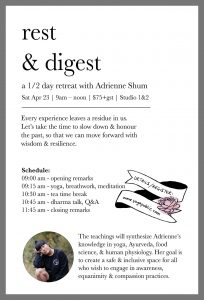
rest & digest: a 1/2 day retreat in April

rest & digest 1/2 day retreat adrienne shum yoga public

***UPDATE: SOLD OUT! THANK YOU!!!***

Join me for a half-day retreat in-person at Yoga Public (Sat Apr 23rd, 9 am – noon) in which we can dive deeper into the practice. A retreat gives us the chance to slow down and process the ups and downs of the past two years, and to honour what we’ve experienced, so that we can move forward with a sense of cohesion and meaning.

Challenging experiences (whether big or small) can leave a residue in both our bodies and minds. Practice can be a way to metabolize these experiences, both through addressing the physical digestive system, and the mental/emotional processes by which we learn to integrate the past.

Expect:

  • A nourishing yoga practice that promotes the body’s ability to heal via focusing on the physical digestive system
  • Meditation practice(s) that teach us to allow for emotions and sensations (mental digestion)
  • An interactive discussion on what these practices are all about and how they can apply to daily life
  • A gentle environment that supports healing and compassionate self-inquiry
  • Simple self-care practices and food for thought as you move forward in life’s journey

You’ll also receive access to an audio recording of a guided meditation created by me to digitally support you after the retreat.

Let’s pause and de-clog!

To register, please visit www.yogapublic.com/workshops

Control issues and working with our blind spots

I’m writing this on a crisp April day and, while there is blue in the sky, there are warnings of a huge blizzard coming to disrupt our wavering steps towards spring.

Cue panic!
Cue despair!

If there was ever needed another reminder that we can’t control everything, then here it is (again). We really can only do so much!

It’s interesting to observe how much energy we spend on worrying about things we can’t control (like clouds, or say, the past). How much time do we lose wondering what others think of us? How much brain power do we expend trying to stop the inevitability of change itself?

We all do this. Maybe we just get caught up, or it’s a distraction from dealing with our own things, but we leak energy over this and that as we try to control what is beyond our personal control – until we don’t have enough energy for what we really want to do, or what we actually have control over.

anxiety is information - adrienne shum

Practice is a way to regather energy, to plug the leaks. We can get both rest and power from our practice. When I’m on my mat or cushion, there is nowhere else to be. And when I rise, I ask: where can I be effective? Where can I serve?

We all have blind spots. Through practice, we can learn to see them, bit by bit. We hold ourselves in compassion as we uncover embarrassing and vulnerable things about ourselves. We hold ourselves in our human-ness. And then, whenever we know better, we try to do better – this to me is the definition of maturity and wisdom.

Here’s to uncovering our blind spots with humility and grace,
Adrienne